








You have decided it is time to move from the bassinet to the crib. Now the question is practical: What needs to be ready before the first crib sleep?
The transition does not require a complete reinvention of bedtime. Prepare the new sleep space, keep the familiar parts of the routine and give your baby time to adjust.

The short answer
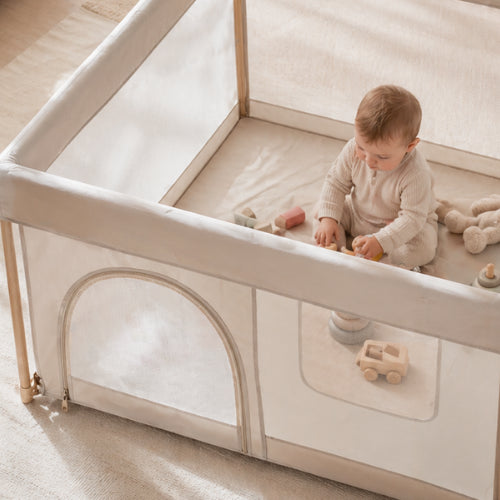
Prepare a correctly assembled crib, a firm mattress that fits it tightly, a fitted sheet and the bedtime cues your baby already knows. Set everything up before the first crib sleep so the new sleep surface is the main change—not the entire routine.
Before you begin: confirm that it is time to transition
This guide starts after the decision, but one check still matters: your baby should leave the bassinet before reaching the first stop-use limit in its manual. That may be a maximum weight, a height limit or a developmental milestone.
The CPSC describes the bassinet category as intended for roughly the first five months or until a baby begins pushing up on hands and knees. Your specific product may set a different or earlier limit, so use its instructions rather than a universal age.
Once the decision is made, shift the question from “When?” to “What needs to be ready?”
Step 1: Complete the crib sleep space
A bassinet normally arrives with its own sleep pad. A crib is often just the frame until you add the mattress. That makes the transition the moment many parents first realize they still need one.
Before the first crib sleep, prepare three essentials:
- a crib assembled according to its instructions and, especially if it is secondhand, checked in the CPSC recall database;
- a firm, flat mattress designed for that crib and fitting tightly at the edges; and
- a fitted sheet sized for the mattress.
The AAP's safe-sleep guidance keeps the rest simple: place your baby on their back and leave pillows, blankets, bumpers, toys, mattress toppers and other soft items out of the crib.
Prepare the mattress before the first night
Do not wait until bedtime to discover that the mattress has not fully expanded or does not fit as expected.
- Check compatibility. Compare the mattress dimensions with the crib manufacturer's requirements and confirm a tight fit.
- Use the infant side. If the mattress is dual-sided, begin with the side designated for infants.
- Unbox it early. Allow a compressed mattress to expand fully according to its model-specific instructions.
- Follow the care directions. Wash removable covers only as instructed and make sure every component is fully dry before reassembly.
- Add the fitted sheet last. Do not add extra padding beneath or above it.
Fit and infant firmness come first. After that, practical preferences—such as a removable cover, waterproof protection, more airflow or the ability to clean beyond the surface—can help narrow the choice. The Babelio crib mattress collection brings those different ownership priorities together; model-by-model comparison belongs in a separate buying guide.
Step 2: Decide where the crib will go
Moving to a crib does not automatically mean moving to a separate room.
The AAP recommends room-sharing without bed-sharing for at least the first six months. If your family is not ready for the nursery, the crib can remain in your room when the available space and crib instructions allow.
Keeping the crib in the same room can also make the transition more focused: the sleep surface changes, while the room, sounds and your proximity stay familiar.
Step 3: Choose the first crib sleep
There is no required order. Choose the starting point your family can repeat consistently.
- Start with a nap if you want to introduce the crib during a shorter sleep period.
- Start at night if your bedtime routine is more predictable than daytime naps.
Whichever you choose, use the crib for that sleep from the beginning rather than moving a sleeping baby between multiple surfaces as part of the plan.
Step 4: Keep the bedtime cues familiar
The crib is already a meaningful change. The rest of bedtime does not need to change with it.
Keep the same sequence your baby recognizes: feeding, a diaper change, dim lights, a song, a short story or white noise used according to its instructions. Familiar cues help preserve the rhythm of bedtime even when the sleep surface is new.
Avoid introducing several unrelated changes on the same night when you have a choice. Moving rooms, changing the routine and removing a familiar sleep cue all at once can make it harder to understand what your baby is responding to.
Step 5: Give the new sleep space time
An unsettled nap or first night is not an instant verdict on the crib. Your baby may need time to become familiar with its larger space and different surface.
Stay consistent with the setup and routine you prepared. If your baby has already exceeded the bassinet's stop-use limit, do not return to it simply because the crib feels unfamiliar.
The first night is only the beginning
The checklist prepares the crib for the first night. The mattress is the part that stays beneath every nap and every night after it.
That long-term role is where Babelio’s belief in Safety That Frees becomes tangible. We design crib mattresses to help parents protect what matters without adding more uncertainty to daily life—through firm infant support, clear fit information and practical care for everyday messes.
In sleep, that belief becomes simple: Safer sleep. Freer nights.
Frequently asked questions
What age should a baby move from a bassinet to a crib?
There is no universal age. Move before your baby reaches the first weight, height or developmental stop-use limit in the bassinet manual.
What do you need to transition from a bassinet to a crib?
Prepare a correctly assembled crib, a firm, flat mattress that fits tightly, a fitted sheet and a familiar bedtime routine.
Does moving to a crib mean moving the baby to their own room?
No. The crib can remain in the parents' room. Changing sleep spaces and changing rooms are separate decisions.
Should the first crib sleep be a nap or nighttime?
Either can work. Choose the sleep period with the more predictable routine and use the same approach consistently.
What if my baby does not settle in the crib?
Keep the setup and bedtime cues consistent and allow time for adjustment. If the bassinet has already reached a stop-use limit, do not return to it because the crib feels unfamiliar.
How long should a compressed crib mattress expand before use?
Follow the instructions for your exact model. Use it only after it has fully expanded and settled as directed.