




Baby-proofing has always meant a visual compromise — white metal frames cutting across carefully designed rooms. But the dominant interior trend of 2026 is making that tradeoff unnecessary.
Organic Modernism — the design movement built on warm natural materials, soft curves, and biophilic elements — has moved well beyond furniture and lighting. It's now reaching every functional layer of the home, including safety hardware. According to Houzz's 2026 Home Design Trends Report, honey-toned woods, matte textures, and earth-palette metals are the top three material preferences among homeowners renovating this year. Meanwhile, Pinterest's annual trend forecast identified "warm minimalism" as one of its fastest-growing search categories, with wood grain finishes seeing a significant increase in saves across nursery and family-room boards.
The implication for parents is straightforward: safety gates no longer need to look like safety gates.
Full disclosure: we're Babelio, and we manufacture the gates discussed below. But the design principles in this guide apply to any gate you're considering. If wood grain works in your space, you'll know it regardless of the brand.
Why Wood Grain Works in Functional Hardware
The appeal of wood grain in a baby gate isn't just cosmetic. There's a practical logic to it that aligns with how Organic Modern interiors are actually built.
Most homes in this style anchor their palette around one or two natural wood tones — typically drawn from flooring, stair railings, or built-in shelving. A white or gray metal gate introduces a material that exists nowhere else in the room. It becomes the most visible object precisely because it doesn't belong.
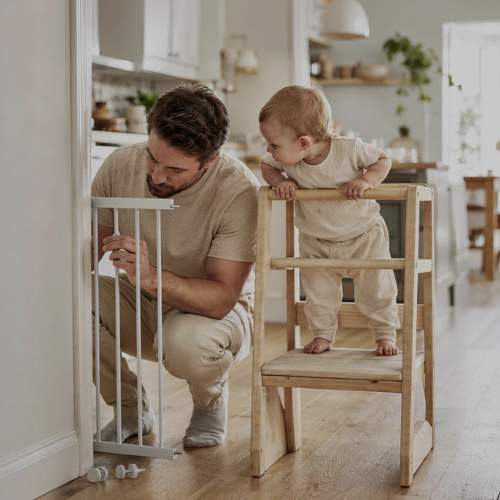
A wood-grain gate, by contrast, picks up the tones already present in the space. When the finish is close enough to the surrounding woodwork, the gate reads as architecture rather than as a temporary childproofing add-on. Designers sometimes call this "material continuity" — the principle that fewer competing materials in a sightline create a calmer, more cohesive room.
This matters even more in open-plan layouts, where a gate at a hallway or staircase opening is visible from the kitchen, living room, and dining area simultaneously.
Why Not Real Wood?
Solid wood gates exist, and they're beautiful. But for a high-traffic safety device that gets opened and closed dozens of times a day, wood has real limitations. It can splinter under repeated impact, warp in humid climates (bathrooms, kitchens), and become a chewing target for teething puppies or toddlers. Chipped wood also creates sharp edges — exactly what you're trying to prevent.
The alternative is a steel-core gate with a wood-grain surface finish. You get the visual warmth of wood with the structural performance of metal. The key is how the finish is applied — cheap vinyl wraps peel at the edges within months. Higher-quality processes like water transfer printing (also known as hydrographic printing) work differently: the grain pattern is floated on water, and the steel frame is submerged through it, allowing the pattern to wrap around the full circumference of every bar and joint — no seams, no bare spots. The result is a matte, textured surface that resists scratching and doesn't reflect light the way gloss finishes do. In high-end interiors, matte always reads more like real material than gloss.
How to Match a Wood Grain Gate to Your Space
Not all wood tones are equal, and picking the wrong one is worse than sticking with plain white. Here's a practical framework:
Match to your dominant wood, not your accent wood
Look at your floors and stair railings — those are the largest wood surfaces in the room and set the baseline tone. A gate that matches a small wooden shelf but clashes with the floor will look off.
Warm vs. cool undertones matter more than light vs. dark
A light oak gate in a room with cool-toned gray-washed floors will feel disjointed even though both are "light wood." Pay attention to whether your existing wood leans warm (golden, amber, honey) or cool (gray, ashy, taupe) and match accordingly.
When in doubt, go slightly darker
A gate that's one shade darker than the surrounding wood tends to look intentional — like a deliberate design accent. A gate that's slightly lighter than everything else tends to look faded or cheap.
Consider sightlines from adjacent rooms
In open-plan spaces, walk to the farthest point from where the gate will be installed and look back. That's the view you'll see most often. If the gate blends at that distance, you've got the right match.
Babelio's Wood Pattern Series: What We Built and Why
We designed our Wood Pattern collection specifically to work within the Organic Modern palette. Here's how each model fits different installation scenarios.
For Staircase Tops: Boundless B17 Wood Pattern
The top of a staircase is the highest-risk location in any home, and it's also one of the most architecturally visible — often directly in the sightline from the main living area. A gate here needs to be both structurally immovable and visually quiet.
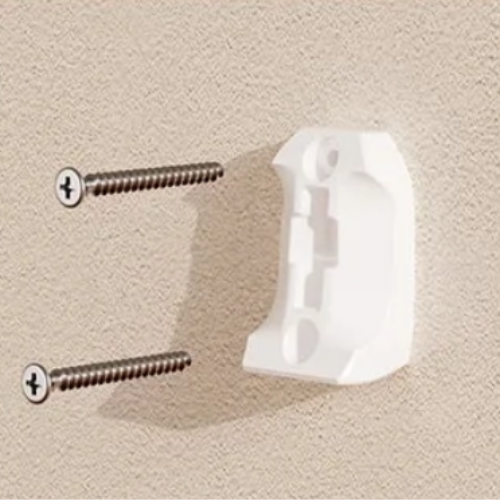
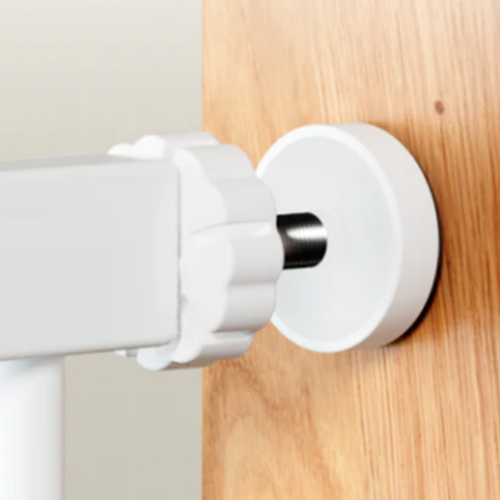
The B17 is hardware-mounted (the only safe option for stairs), with a no-bottom-bar design that eliminates tripping hazards. It scored 97 out of 100 in a 2026 evaluation by a leading independent U.S. consumer testing laboratory, ranking #1 among all hardware-mounted gates tested.
It's available in two finishes — Natural Wood (for honey and oak-toned spaces) and Brown Wood Pattern (for walnut and darker palettes). The matte water-transfer finish wraps the full steel frame — including round bars and joints — so there's no visible seam or edge where the pattern stops.

For Doorways and Hallways: PressGuard P7 Wood Pattern
The P7 uses pressure mounting — no drilling required — making it ideal for rental homes or spaces where you don't want permanent hardware. It also earned the #1 ranking among pressure-mounted gates in the same independent 2026 consumer report.
Where the P7 particularly shines in Organic Modern interiors is at the boundary between rooms with different flooring. A wood-grain gate at the transition point between, say, a hardwood hallway and a tiled kitchen acts as a visual bridge, softening what would otherwise be an abrupt material change.

For Multi-Pet Homes: CatPrivilege Wood Pattern
If you have both dogs and cats, the CatPrivilege adds an integrated cat-sized pass-through door to the same wood-grain frame. The cat moves freely; the dog stays contained; and the gate still looks like it belongs in the room.

A Note on "Invisible Safety"
We sometimes describe the goal of our Wood Pattern series as "invisible safety" — not because the gate literally disappears, but because it stops registering as a foreign object in the room. When a gate matches its surroundings well enough, your eye skips over it the way it skips over a door frame or a baseboard. It's still there, still working, still protecting — but it's no longer the thing you notice first when you walk into the room.
That's what we think safety should feel like in 2026: present but not intrusive, strong but not harsh, functional but not ugly.
This guide was written by the Babelio design and product team. We manufacture steel-core safety gates with wood-grain finishes. Product recommendations in this article are our own; the design principles are universal. For more on Organic Modern interior trends, see Houzz and Architectural Digest.


1 comment
Gilda Selchau
We’re looking for a sturdy, secure and attractive safety gate for the top of the stairs for a senior couple who has balance issues? Can you recommend one of your gates for this purpose? If not, can you recommend other designer/builders? We live in the San Francisco Bay Area. Many thanks.
We’re looking for a sturdy, secure and attractive safety gate for the top of the stairs for a senior couple who has balance issues? Can you recommend one of your gates for this purpose? If not, can you recommend other designer/builders? We live in the San Francisco Bay Area. Many thanks.